Post-doc position in insect olfaction and behaviour
General information
Workplace: MONTPELLIER
Scientific Responsible name: Magali Proffit
Type of Contract: CDD Contract Period: 24 months
Start date of the thesis: 1 January 2020
Proportion of work: Full time
Remuneration: between 2 600 and 3 000€ based on the experience (gross monthly)
Description of the project
Pollination by insects is a key component of biodiversity, providing a fundamental service in natural and agricultural ecosystems. A series of major threats to insect pollination have been identified, and political lines of action have been proposed. Surprisingly, the vulnerability of plant-pollinator interactions to a major facet of global change, increasing air pollution and particularly increasing ozone (O3) concentrations, has been largely neglected. However, due to its strong oxidizing potential, tropospheric O3 is one of the most damaging air pollutants affecting ecosystems in rural areas. However, nothing is known about critical levels of O3 pollution for the resilience of plant-pollinator interactions. Recent studies show that elevated O3 modifies the composition of the blend of volatile organic compounds (VOCs) emitted by flowers and their lifetime during their transport in the atmosphere. These VOCs are used by insect pollinators to locate flowers, and are therefore decisive for ensuring pollination.
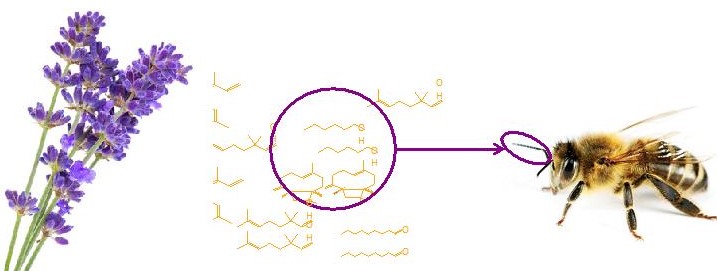
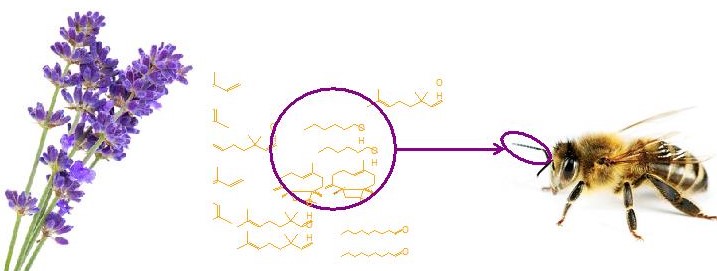
The aim of this project is to investigate the impact of elevated O3 concentrations on the attraction of pollinators to their host plant. The generalist interaction between Lavandula angustifolia and Apis mellifera will be used as a model system. Our working hypothesis is that O3, because of its strong oxidative properties, has an impact at each step involved in plant-insect chemical communication, affecting (1) the emission of plant VOCs; (2) the life-time of VOCs in the atmosphere; (3) the detection of the VOCs by pollinators. Therefore this project is divided in 3 tasks.
In the context of this project, a post-doc position is available at the “Centre d’Ecologie Fonctionnelle et Evolutive” at CNRS in Montpellier for 24 months, funded by the ANSES (PI: Magali Proffit).
Main activities
The post-doc will have to set up behavioural test as well as conducting electro-physiological tests on Apis mellifera in order to test the impact of different situations of O3 on the detection of VOCs by pollinator’s antennae and their behaviours towards lavandula VOCs (task 3 of the project). In addition, the post-doc fellow will have to conduct experiments in the context of the tasks 1 and 2 of the project with a PhD student and to participate to the supervision of master students.
Skills and qualification
We are looking for a dedicated fellow with a PhD in neurobiology or behavioural ecology. The candidates should have a solid knowledge in behavioural ecology as well as practical knowledge of manipulation of honeybee colonies. Previous experience with olfactory conditioning of proboscis extension reflex (PER) would be positively appreciated. More generally, the candidate must have a good degree of autonomy, a good level of English and the ability to work in a team.
Working context
Most researches will be conducted at the CEFE (UMR 5175). This research institute is one of the largest French research centre in Ecology. In addition, it hosts an important platform of chemical analysis.
In the daily basis, candidate will interact with the research team and students directly associated to the project, as well as with national and international collaborators.
Risk and constraints
Working with honeybees.
Additional information
The project is founded by the “Agence nationale de sécurité sanitaire de l’alimentation, de l’environnement et du travail” (ANSES).
Applications should be done through the portal https://emploi.cnrs.fr/Offres/CDD/UMR5175-MAGPRO-002/Default.aspx?lang=EN (English version) or https://emploi.cnrs.fr/Offres/CDD (version Française) before September 4th. Applicants should upload a full CV (including contact details of two references) and a letter explaining their motivation and achievements. For successful applicants, hearing will be organized between September 16th and 27th. For more information contact (magali.proffit@cefe.cnrs.fr).